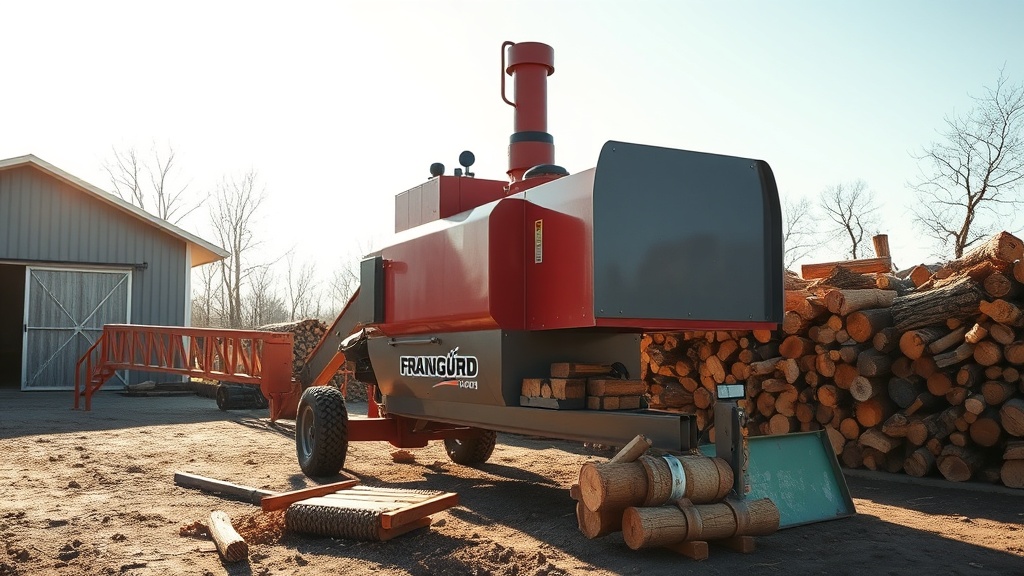
Introduction: Why Compare the Fransgård TC-10 and the WoodMaxx WM-8T?
When choosing a firewood processor for moderate to high-volume production, two machines often come up in serious discussions: the Fransgård TC-10 and the WoodMaxx WM-8T. Both are robust, self-contained units capable of cutting, splitting, and conveying firewood in a single pass. However, they target slightly different segments of the market, and understanding the nuances in design, hydraulic performance, and long-term reliability is crucial before investing anywhere from £8,000 to £15,000 or more. This article provides a detailed, honest comparison to help you decide which machine aligns with your operational needs and budget.
We will examine power, split capacity, build quality, and real-world usability, drawing on technical specifications and owner feedback. Whether you are a professional firewood supplier or a serious homesteader looking to process dozens of cords per season, the information here will clarify the choice between these two popular processors.
How Do the Fransgård TC-10 and WoodMaxx WM-8T Compare in Engine Power and Hydraulic Performance?
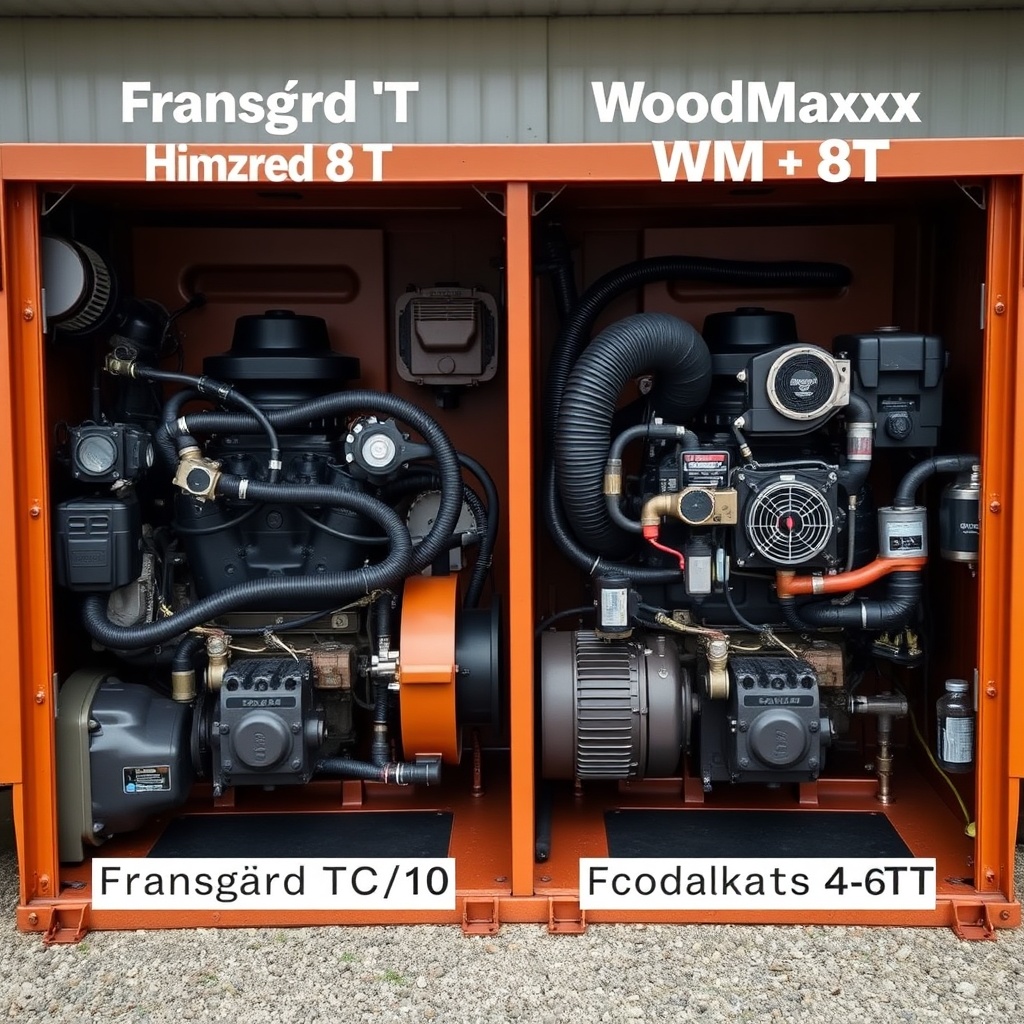
The engine is the heart of any firewood processor, and both the Fransgård TC-10 and the WoodMaxx WM-8T use reliable, air-cooled gasoline engines—typically a Honda GX390 or similar 13 hp unit for the Fransgård, and a 14 hp Briggs & Stratton or Honda on the WoodMaxx. On paper, the power difference is minimal, but the real story lies in the hydraulic systems they drive.
The Fransgård TC-10 features a closed-loop hydraulic system with a dedicated 3-stage gear pump that delivers 11 gallons per minute (GPM) at 2,200 psi. This setup provides consistent pressure for the 10-ton splitter ram and the 12″ diameter saw blade. The WoodMaxx WM-8T uses a similar gear pump but with a slightly higher flow rate of 12 GPM at 2,500 psi, yielding a splitter force of approximately 12 tons. In practice, the Fransgård’s hydraulics are tuned for steady, repeatable cycles, while the WoodMaxx’s higher pressure can force through tougher, knotty wood more aggressively. However, the Fransgård’s system is known for superior thermal management, with a larger oil cooler that prevents overheating during extended runs—a key advantage in summer firewood processing. For a deeper dive into hydraulic specifics, see our Fransgård TC-10 Hydraulics and Performance: A Technical Analysis.
Another distinction is the pump engagement. The Fransgård uses a mechanical clutch that disengages the pump when not cutting, reducing fuel consumption and noise. The WoodMaxx keeps the pump spinning continuously, which can lead to slightly higher fuel usage but provides instant hydraulic pressure on demand. For most operators, the Fransgård’s approach is more efficient for stop-and-go work, while the WoodMaxx’s constant pressure is better for non-stop production.
What About Cutting and Splitting Capacity: Which Machine Handles Larger Logs Better?
Firewood processors earn their keep based on how fast and safely they can turn a log into split pieces. The Fransgård TC-10 accepts logs up to 10 inches in diameter and 20 inches in length—though with the optional extended bed, length can go to 24 inches. The WoodMaxx WM-8T handles a slightly larger 8-inch diameter (despite the name, it’s actually an 8-inch capacity, but the “8T” refers to the splitter tonnage, not log size; confusion is common). In reality, the Fransgård’s 10-inch opening is a significant advantage for processing larger hardwood rounds like oak or maple without needing to pre-split.
The saw bar on the Fransgård is a 14-inch Oregon bar with a 0.325″ chain, while the WoodMaxx uses a 16-inch bar with a 3/8″ chain. The WoodMaxx’s larger bar can handle logs up to 10 inches in diameter if the operator tilts the log—but the Fransgård’s wider throat is less dependent on operator technique. In terms of splitter wedge, the Fransgård uses a 4-way wedge as standard, splitting logs into four pieces in one stroke. The WoodMaxx comes with a 2-way wedge standard but offers an optional 4-way upgrade. This makes the Fransgård more turnkey for high-volume four-way splitting out of the box.
Cycle times are comparable: the Fransgård’s saw cuts through a 10-inch log in about 3–4 seconds, and the splitter wedge cycles in 6–8 seconds (forward and return). The WoodMaxx is slightly faster on the splitter—about 5–6 seconds—due to higher flow. For a production scenario processing 2 cords per hour, the Fransgård’s ability to handle larger logs without manual intervention often offsets the slight speed deficit. However, for smaller, consistent-diameter logs (6–8 inches), the WoodMaxx’s faster splitting cycle yields a higher pieces-per-minute rate.
Build Quality, Durability, and Portability: Which Machine Lasts Longer and Moves Easier?
Firewood processors take a beating from dirt, moisture, and heavy loads. The Fransgård TC-10 is built in Denmark with a powder-coated steel frame and stainless steel fasteners in critical areas. The splitter beam is 1/4-inch steel, and the conveyor belt is a heavy-duty cleated rubber design. Owners consistently report that the Fransgård feels “overbuilt” for its class, with tight tolerances and minimal vibration. The WoodMaxx WM-8T, manufactured in China but assembled in the USA, uses similar gauge steel but has been noted for occasional weld quality inconsistencies—especially around the log tray mounts and conveyor pivot points. That said, WoodMaxx has a strong reputation for customer service and provides a 3-year warranty on most components.
Portability is where the Fransgård has a clear edge. The TC-10 comes standard with a 2-inch ball hitch, adjustable tongue jack, and highway-rated tires (13-inch wheels). It weighs approximately 950 pounds (without log splitter wedge and conveyor folded), and the overall design is balanced for towing at speeds up to 55 mph. The WoodMaxx WM-8T weighs about 1,100 pounds and uses a similar towable frame but with smaller 8-inch wheels that limit towing speed to 25 mph. For operators who need to move the processor between job sites or store it in a tight garage, the Fransgård is far easier to maneuver and tow safely on public roads.
Another durability differentiator: the Fransgård’s hydraulic hoses are fully encased in protective sleeves, while the WoodMaxx’s hoses are routed loosely and can rub against the frame over time. This is a small detail that speaks to overall engineering care. For routine maintenance guidance, our Fransgård TC-10 Maintenance Checklist: Routine Care for Longevity covers everything from greasing points to hydraulic fluid checks.
Price, Value, and Total Cost of Ownership: Which One Offers Better Value for Money in GBP?
Pricing varies by dealer and season, but as of late 2024, the Fransgård TC-10 typically retails between £8,500 and £9,800 depending on included accessories (e.g., extended bed, 4-way wedge, log lift). The WoodMaxx WM-8T is generally priced between £6,200 and £7,500 USD (£4,900–£5,900 GBP at current exchange rates, though UK import costs may add 20% VAT and shipping). For British buyers, the Fransgård has the advantage of being available through established European dealers with service centers in the UK, reducing shipping costs and import duties. The WoodMaxx, being a US-focused brand, often requires a freight forwarder and may not have local warranty support.
To clarify the cost differences, here is a comprehensive specification and price comparison table:
| Specification | Fransgård TC-10 | WoodMaxx WM-8T |
|---|---|---|
| Engine (typical) | Honda GX390 (13 hp) | Briggs & Stratton 14 hp |
| Hydraulic Flow | 11 GPM @ 2,200 psi | 12 GPM @ 2,500 psi |
| Splitter Force | 10 tons | 12 tons |
| Max Log Diameter | 10 inches (throat) | 8 inches (10 with tilt) |
| Max Log Length | 20 inches (24 optional) | 20 inches |
| Wedge (standard) | 4-way | 2-way (4-way optional) |
| Saw Bar Size | 14-inch, 0.325 chain | 16-inch, 3/8 chain |
| Saw Displacement | 62 cc | 66 cc |
| Cycle Time (split) | 7–8 seconds | 5–6 seconds |
| Weight | 950 lbs (431 kg) | 1,100 lbs (499 kg) |
| Towing Capacity | 55 mph rated, 13″ wheels | 25 mph rated, 8″ wheels |
| Warranty | 2 years (parts only) | 3 years (parts + labor) |
| Price (UK typical) | £8,500 – £9,800 | £4,900 – £5,900 (import) |
| Oil Cooler | Large, finned | Standard tube |
| Hose Protection | Sleeved | Exposed |
When factoring in total cost of ownership over 5 years, the Fransgård’s higher initial price is offset by lower maintenance costs (better component protection) and higher resale value (used TC-10s typically hold 70% of original value after 3 seasons). The WoodMaxx, while cheaper to buy, may require more frequent repairs (e.g., weld rework, hose replacement) and has lower resale in the UK market. For operators considering financing, the Fransgård often qualifies for European agricultural equipment loans, while the WoodMaxx may not.
Ease of Operation and Safety Features: Which Is More User-Friendly for Beginners?
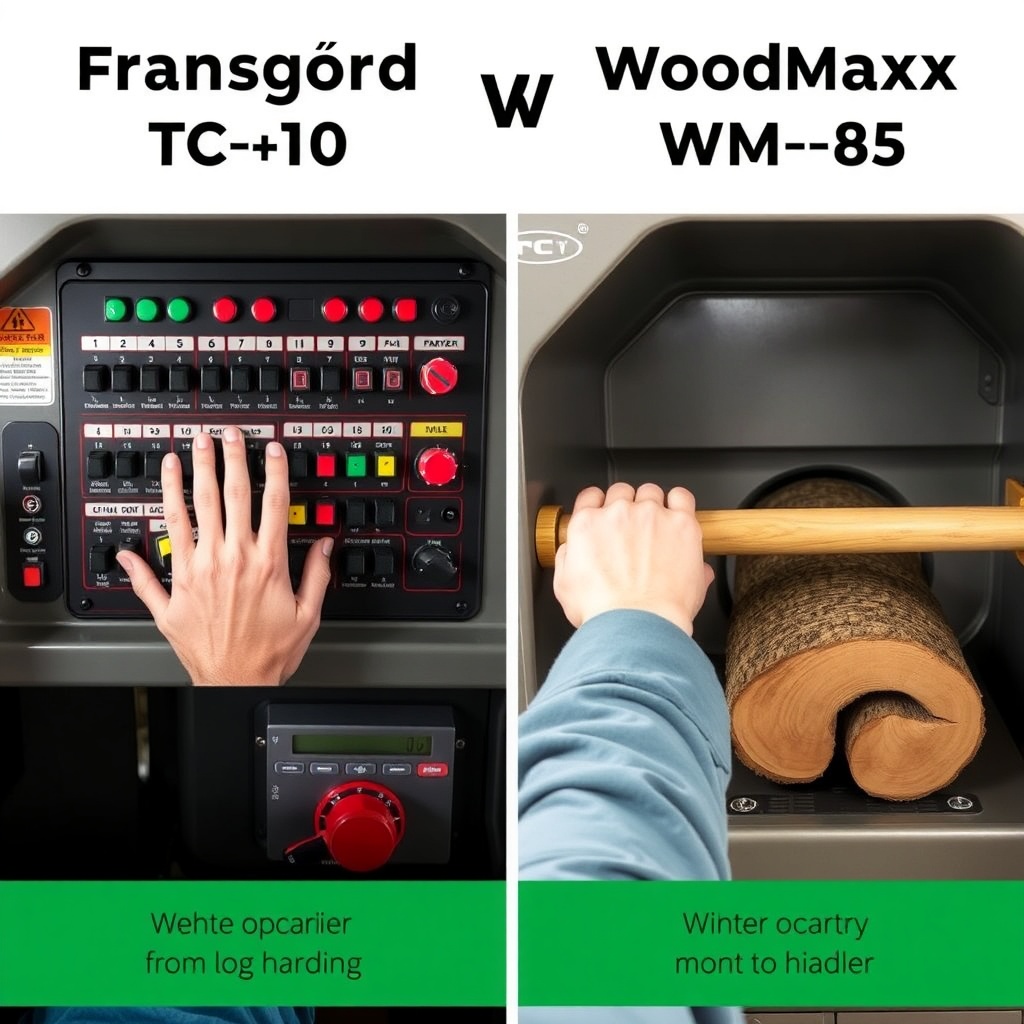
Operating a firewood processor involves inherent risks from moving saws, hydraulic cylinders, and ejecting wood pieces. The Fransgård TC-10 prioritizes operator safety with a two-handed start sequence, a safety bar that stops the saw if pushed, and a foot pedal that activates the conveyor only when depressed. The splitter cycle requires a deliberate lever pull, and the wedge automatically retracts after reaching maximum stroke. The WoodMaxx WM-8T has similar basic safety features but relies more on operator proximity control—the saw is activated by a hand lever that can be accidentally bumped if the operator is not careful. The Fransgård’s design is more intuitive for beginners: controls are color-coded and placed on a panel next to the operator position, with clear Fransgård TC-10 Safety and Operation: Essential Tips for Beginners documentation included.
Another user-friendliness factor is the log tray. The Fransgård uses a gravity-fed tray that tilts automatically when loading, reducing back strain. The WoodMaxx has a fixed tray that requires manual lifting onto the saw cradle. For operators processing 2+ cords in a day, this ergonomic difference is significant. The Fransgård also features a built-in log lift as an accessory (Top Accessories for Fransgård TC-10), which the WoodMaxx lacks entirely. Beginners also appreciate the Fransgård’s quick-tensioning chain adjuster (no tools required), whereas the WoodMaxx uses a traditional screw-and-nut system.
What Owners Say: Real-World Experiences from the Field
Feedback from actual owners paints a clear picture of each machine’s strengths and weaknesses. On the Fransgård TC-10, owners consistently praise its ability to handle wet, knotty wood without stalling. “I’ve run 4 cords of green red oak through my TC-10 in a day, and it didn’t even hiccup,” says David M., a firewood contractor in Shropshire. “The hydraulics stay cool even in July. My only frustration is that the conveyor could be a few inches longer—some of my split pieces fall before reaching the pile.” Another recurring comment: the 4-way wedge can occasionally stick when splitting large crotch pieces, but a quick tap with a hammer solves it. For troubleshooting, see Fransgård TC-10 Troubleshooting: Common Issues and Fixes.
WoodMaxx WM-8T owners often highlight its speed and value. “For the price, it’s unbeatable. I process 3 cords every two days without any issues,” says Tom R., a part-time firewood seller in Colorado. “But I had to replace the hydraulic hoses twice in the first year because they got pinched. The frame also needs extra bracing near the saw mount if you’re going to run it hard.” A common sentiment among US owners is that the WoodMaxx is a great entry-level processor, but those who move up to the Fransgård after a season or two rarely regret it. “I bought a used TC-10 and sold my WoodMaxx after six months,” says John L. of Oregon. “The Fransgård just feels more solid, and I can trust it with my biggest oak logs.”
Frequently Asked Questions
Q1: Can the Fransgård TC-10 be used in the rain or wet conditions?
A1: Yes, the Fransgård TC-10 is designed for outdoor use with weather-resistant components, including a coated electrical system and stainless steel fasteners. However, it is not fully waterproof—do not directly hose the engine or control panel. Always allow the chainsaw bar to cool before cleaning to avoid thermal shock.
Q2: What is the fuel consumption of the Fransgård TC-10 per hour?
A2: Under normal load (splitting 1–1.5 cords per hour), the Honda GX390 consumes about 1.2 litres per hour (0.3 gallons). Idling and light work reduce consumption slightly. We recommend using non-ethanol fuel to prevent carburetor issues over time.
Q3: How often should I change the hydraulic fluid in the Fransgård TC-10?
A3: Change the hydraulic fluid every 200 operating hours or once per season, whichever comes first. Use ISO 32 or AW 32 hydraulic fluid (approximately 6 litres). For a complete procedure, please refer to our Fransgård TC-10 Hydraulic Fluid Change: Step-by-Step Guide.
Q4: Is the WoodMaxx WM-8T compatible with a European 230V 50Hz single-phase system?
A4: No, the WoodMaxx WM-8T is designed for 120V 60Hz (US standard) for its optional electric start and accessory lights. Using a step-down transformer is not recommended as the engine’s ignition system may still be affected. The Fransgård TC-10 is built for 230V European electrical systems.
Q5: Can I use the Fransgård TC-10 with a 3-point hitch instead of towing?
A5: No, the TC-10 is not designed for 3-point hitch mounting. It is a standalone, towable unit. However, some operators have fabricated a custom mounting bracket for stationary use, but this voids the warranty. WoodMaxx does not offer a 3-point option either.
Q6: Which machine has a better warranty in the UK—Fransgård or WoodMaxx?
A6: The Fransgård TC-10 comes with a 2-year parts warranty (labour costs not included) from authorized UK dealers. WoodMaxx offers a 3-year warranty (parts and labour) but only through US-based dealers. For UK buyers, the Fransgård’s local support network is significantly more accessible and reliable for warranty claims.